In plain English
This page is part of the technical reference. It keeps the expert detail but starts with a plain-language summary for first-time readers.
- Why this matters: AI risk can come from the whole arrangement, not one obvious model.
- What to look for: data, memory, routes, adapters, tools, evaluators, updates, and rollback paths.
- Technical version below: the expert terminology remains available and is linked through the glossary.
Change-Out and New Model Creation
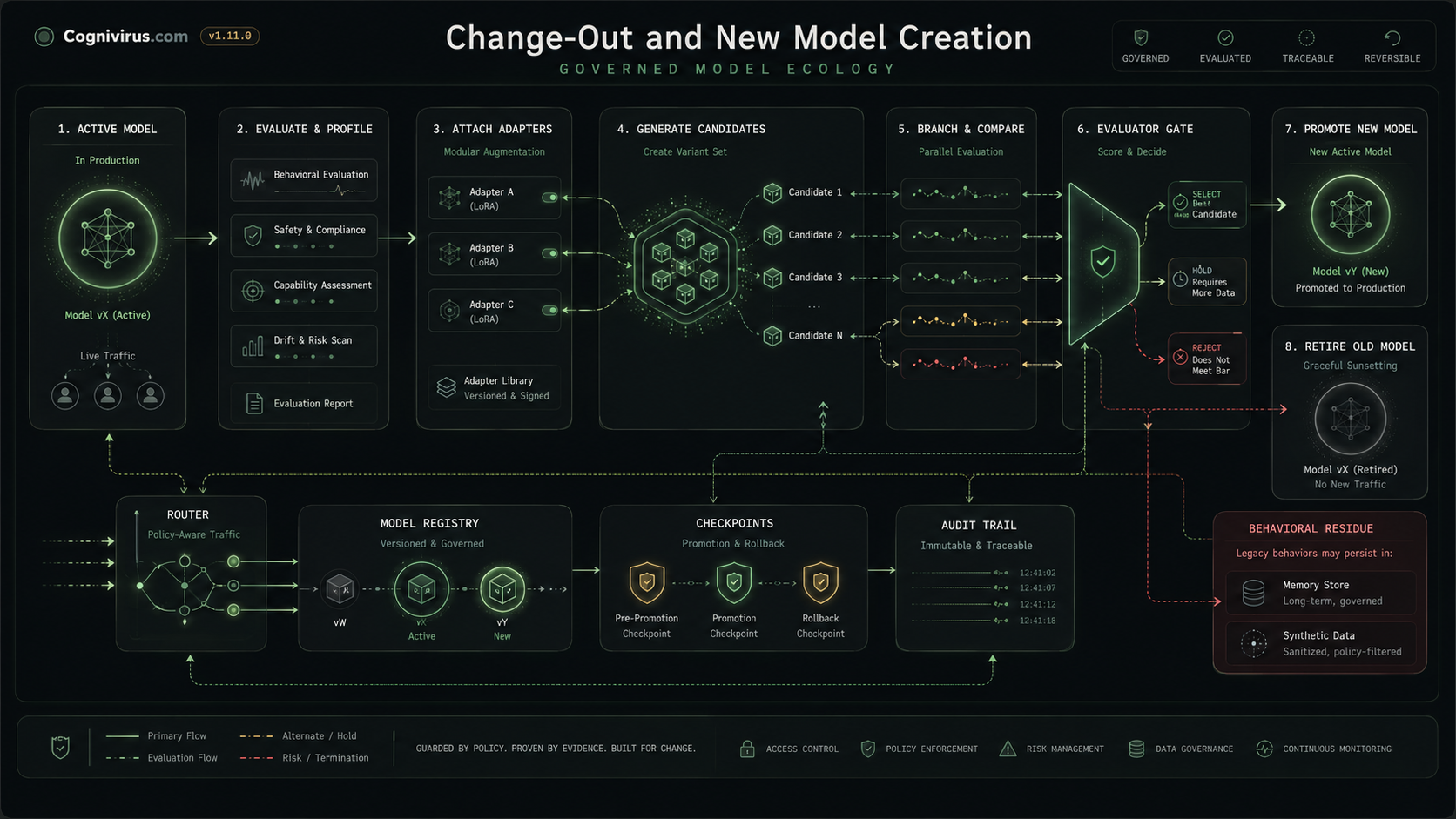
This graph shows how a governed AI model ecologyA changing AI system made from many connected parts, not just one model. Open glossary definition can evaluate an active model, attach adapters, create candidate variants, compare branches, gate promotion, retire the old carrier, and preserve audit evidence.
Change-out and new model creation
This graph shows how a model ecology can change out one active model for a new descendant while preserving audit trails, rollback checkpoints, routing state, memory, and behavioral residue. It is a defensive governance schematic, not a recipe for autonomous replication.
Detail for change-out and new model creation
This page expands the poster into a full-width image/video reading surface. Use it to inspect the chain from active model to candidate branch, evaluator gate, registry promotion, retirement, and residue checks.
What the full page adds
- The old and new model are only part of the system boundary.
- The registry, router, evaluator, memory, and rollback checkpoint decide whether replacement is actually reversible.
- The animation is explanatory. The static poster remains the canonical image and returns after one video pass.
Review surfaces in the image
What to notice
- the old model and new model are not the whole system;
- router state, registry identity, checkpoints, audit trailA record of what happened, who approved it, and when. Open glossary definition, and memory all matter;
- behavioral residueInformation or tendencies left in memory, synthetic data, traces, evaluator preferences, or subsequent training material after a component is retired. Open glossary definition can persist after the old model is retired;
- rollbackReturning a system to an earlier known state. Open glossary definition must name more than weights.