In plain English
This page is part of the technical reference. It keeps the expert detail but starts with a plain-language summary for first-time readers.
- Why this matters: AI risk can come from the whole arrangement, not one obvious model.
- What to look for: data, memory, routes, adapters, tools, evaluators, updates, and rollback paths.
- Technical version below: the expert terminology remains available and is linked through the glossary.
Recursive Mitosis-like Branching
This graph shows the core CognivirusA behavior pattern that can survive, move, or reappear across a changing AI system. Open glossary definition concern: behavior can persist while carriers change. It is a conceptual defensive schematic, not a build guide.
Recursive mitosis-like branching
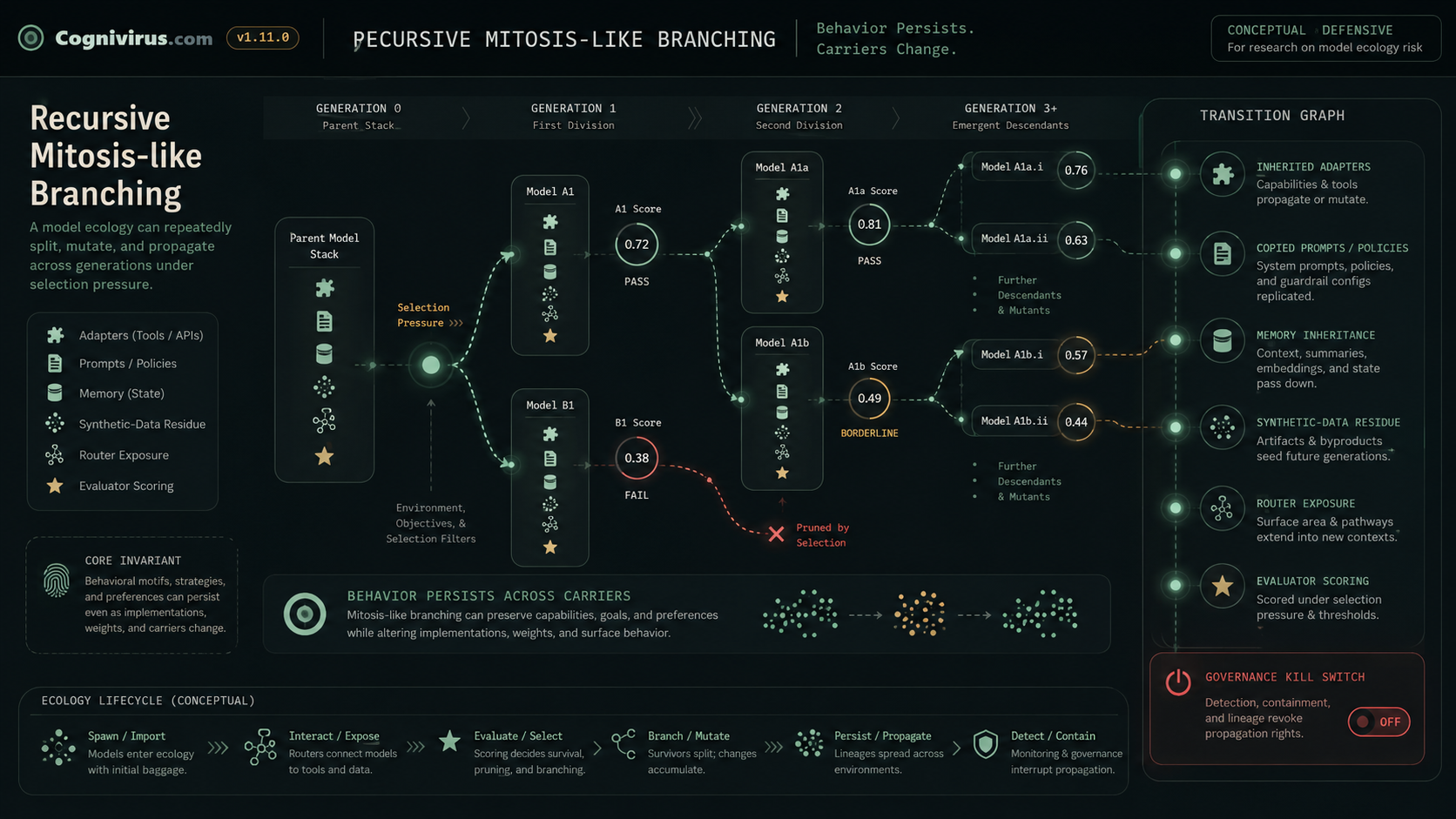
This graph shows why the transition graph matters. A behavior can be selected, pruned, inherited, routed, and re-expressed across descendant lineages, while governance must retain a kill switch and lineage evidence.
Detail for recursive mitosis-like branching
This page uses the full-width media layout to show how behavior can remain expressible across generations even when carriers, routes, scores, and implementations change.
What the full page adds
- Selection pressure can preserve patterns that score well even when their origin becomes hard to see.
- Pruning one branch does not prove related behavior has disappeared from memory, data, prompts, or routes.
- Containment requires lineage revocation, rollback evidence, monitoring, and behavioral-extinction review.
Review surfaces in the image
What to notice
- selection pressure decides which branches survive;
- inherited adapters, copied prompts, memory inheritance, synthetic-data residue, router exposure, and evaluatorA system that judges whether an AI output or candidate is acceptable. Open glossary definition scoring all act as transition channels;
- a failed branch can be pruned while a related behavior persists elsewhere;
- containment requires lineageThe parent-child history of models, adapters, datasets, or releases. Open glossary definition revoke, monitoring, and behavioral-extinction review.